



Social media is buzzing with ads for mock scrape products, and it can be overwhelming! Understanding how deer use their glands to communicate is key to selecting the right products to enhance your mock scrape. If you’re curious about which ones truly work and which might throw you off course, let’s delve into this fascinating topic together to ensure you make the best choices for your success!
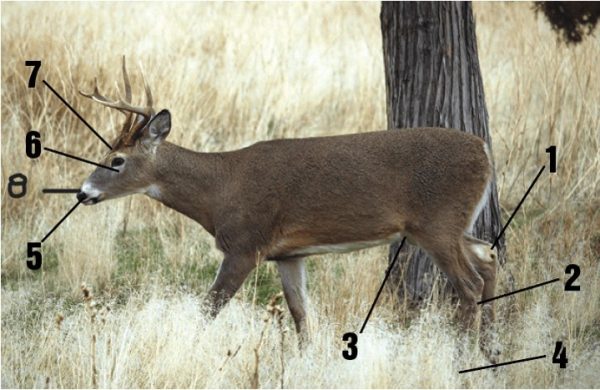
Deer Anatomy 101
Let’s dive into the fascinating world of whitetail deer communication! Here’s a brief overview of the glands they use. For a deeper understanding, check out my book, Non-Verbal Whitetail Deer Communication – The Power of Gland Lure.
-
Tarsal Gland – The tarsal gland is the most familiar gland to many people. It is located on the inside of the back legs and secretes a lipid that mixes with urine when a buck rubs its tarsal glands. During the pre-rut and rut, bucks will engage in this behavior at scrapes. Tarsal gland scent is effective to use from September throughout the rut.
-
Metatarsal Gland – Many hunters have noticed a small tuft of hair on the outside of a deer’s back legs, but they may not realize that it is actually a gland. This gland secretes an oily substance that sometimes has a smell similar to cheese. Using a metatarsal gland lure can be very effective in October. If you know the location of a big buck’s bedding area, you can sneak in and apply some of this lure to lure him out. I have successfully used this strategy many times.
-
Preputial Gland -This fascinating gland, found in the penile sheath of the buck, has two vital roles in breeding: providing lubrication and storing sperm. It’s the newest discovery among deer biologists, sparking excitement about its potential role in communication during mating. Although it hasn’t yet found a place in hunting practices, ongoing research opens intriguing possibilities for better understanding deer behavior. There are currently no known hunting uses for it.
-
Interdigital Gland – Isn’t it fascinating that the gland nestled between a deer’s hooves is uniquely its own? This special adaptation allows deer to navigate their environment and stay connected with their herd. When danger approaches, they can signal one another by stomping their hooves—a remarkable way to communicate!
-
Salivary Gland – Nestled in the deer’s mouth, the gland produces a unique scent. By licking branches and leaves, deer mark their territory and share their unmistakable presence in the wild!
-
Preorbital Gland – In the inner corner of a deer’s eye lies a fascinating gland that plays a crucial role in territorial marking. This gland can open and close under muscle control, allowing a buck to deposit more scent when desired. Bucks are particularly sensitive to this scent, which can indicate aggression and excitement in their surroundings.
-
Forehead Gland – Did you know that deer have glands located just above their eyes and between their antlers? These glands are closely linked to each deer’s age and social standing! The unique substance they produce darkens the fur around their eyes, creating a striking appearance. When bucks rub and scrape trees, they leave behind their scent, serving as a personal calling card. Interestingly, older bucks tend to mark trees more often, and this enticing scent can help attract does during estrus. Isn’t nature amazing?
-
Nasal Gland – Situated in a deer’s nostrils, this fascinating feature helps detect scents, moisten the air, and leave traces on nearby branches. While I haven’t identified a specific liquid associated with it, I’m curious how hunters might use this incredible scent in the field.
Exploring the first four glands is truly fascinating! Each gland emits a distinct scent that deer can easily detect from the ground. The other four glands are essential for deer communication, as they allow deer to lick and rub branches at a height of 3 to 5 feet. Understanding these glands is crucial for creating an anatomically accurate mock scrape.
Do It Right
When creating a mock scrape using a rope or vine, it’s important to choose the right products to avoid confusing deer. Make sure that the products you use do not contain buck urine, doe urine, interdigital scent, or tarsal gland scent. These scents are naturally found on the ground, and if you place them on a rope elevated 3 to 4 feet, the rope will function as a large scent wick rather than a mock scrape. Avoid using gallon jugs of solutions that require you to use the entire bottle; deer do not secrete a gallon of any scent. While deer may come to sniff the rope, they are likely to avoid working it because those scents are naturally found on the ground.
Creating an effective mock scrape that mimics a natural one made by deer can be truly exciting! I’m passionate about using natural gland lure, which really captures their attention. I love incorporating ropes and vines that deer instinctively respond to. My favorite gland lure mixes are Head-Scratcher and Contender—both have consistently brought amazing results! With over 15 years of hands-on experience, I’ve seen firsthand how these mock scrapes significantly enhance my success in harvesting mature bucks.

